Proudly, Terribly Wrong: How Botching Your Home Projects Became the Ultimate American Flex
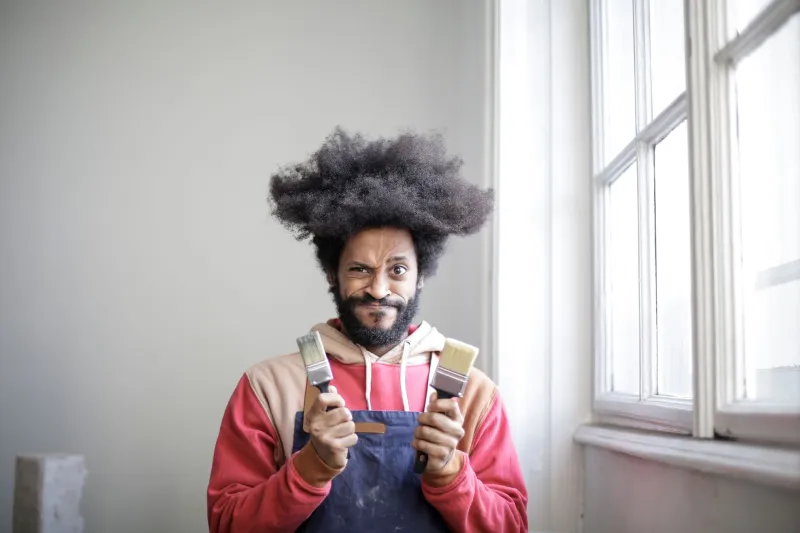
There is a shelf somewhere in suburban Ohio that is held up by three screws, a prayer, and what appears to be a generous application of wood glue applied in a moment of panic. Its owner photographed it, posted it to Reddit, and received 47,000 upvotes. The caption read: "She's not level but she's MINE."
This is where we are now, America. And honestly? It's kind of beautiful.
The Fall of the Flawless Finish
For roughly a decade, home improvement content online existed in one register: aspirational, immaculate, and deeply intimidating. Every kitchen backsplash was a geometric masterpiece. Every poured concrete countertop looked like it belonged in an architecture firm. Every handmade bookshelf seemed to have been constructed by someone who had definitely read at least four books about woodworking and also owned a laser level.
The unspoken message was clear: if yours doesn't look like this, keep it to yourself.
Then, gradually and then all at once, people stopped keeping it to themselves.
What emerged in its place was something rawer, funnier, and infinitely more relatable — a sprawling digital gallery of ambitious attempts gone sideways. Grout lines that seem to be having their own separate conversation from the tiles. Painted accent walls that somehow ended up two shades darker than the can promised and now make the living room feel like the inside of a submarine. Homemade pasta that was technically edible but also technically a crime against Italian culture.
People posted all of it. People celebrated all of it.
The Aesthetic of Glorious Failure
Here's the thing about mediocre DIY content: it has developed its own aesthetic vocabulary, and that vocabulary is remarkably consistent. There's always a "before" photo that radiates misplaced confidence. There's a mid-project shot where you can see the exact moment the person realized something had gone wrong. And then there's the finished product — presented not with shame but with the energy of someone accepting an award they absolutely do not deserve.
The captions are their own art form. "Did I measure twice? No. Did I cut once? Also no." "This is either rustic farmhouse or a crime scene, and I choose farmhouse." *"Pinterest said two hours. It has been four days and I have learned nothing about myself except that I cannot be trusted with a miter saw."
These aren't confessions. They're proclamations.
Communities have formed around the genre. Subreddits dedicated to DIY disasters rack up millions of members. TikTok accounts built entirely around failed renovation attempts pull hundreds of thousands of followers. There's even a growing cottage industry — deeply ironic, given the subject matter — of creators who have monetized their incompetence, landing brand deals with hardware stores and craft supply companies who have apparently decided that chaotic authenticity moves product better than polished expertise.
Why Now? Why This?
The timing isn't accidental. The pandemic sent millions of Americans into their homes with too much time, too much ambition, and just enough YouTube tutorials to make them dangerously overconfident. People who had never held a power drill suddenly decided to retile their bathrooms. People who had never baked anything more complex than a boxed brownie attempted croissants from scratch. The results were, broadly speaking, a disaster — and the documentation of those disasters became a kind of shared cultural language.
But there's something deeper happening here than just pandemic boredom finding an outlet.
Perfectionism, it turns out, is exhausting. The relentless curation of online life — every meal photographed, every home styled, every body filtered — has created a low-grade anxiety that a lot of people are quietly desperate to escape. Posting your wobbly shelf isn't just funny. It's a small act of rebellion against a decade of content that made ordinary people feel like their ordinary lives weren't quite enough.
When someone shares a photo of a cake that was supposed to look like a golden retriever but ended up looking like a golden retriever that has been through something, they're not just sharing a baking failure. They're saying: I tried a thing. It didn't work. I'm fine. You're fine. We're all fine.
That message, in the current cultural climate, hits different.
The Professionals Are Watching (And Nervous)
Not everyone is charmed by the trend. A certain subset of actual craftspeople — the ones who spent years learning joinery or mastering sourdough fermentation — have mixed feelings about watching someone's lopsided bookshelf get more engagement than their perfectly dovetailed cabinet. There's a fair critique buried in there about the way the internet tends to flatten expertise, rewarding personality and relatability over genuine skill.
But most working craftspeople seem to have landed on a more generous interpretation: anything that gets people excited about making things, even badly, is probably net positive for the world. The person who posts their terrible tile job might, six months later, post a slightly less terrible tile job. Progress is progress, even when it starts on a crooked foundation.
The Permission Structure Nobody Asked For
What the mediocre DIY movement has quietly accomplished — beneath all the jokes and the chaotic energy and the inexplicable number of people who thought they could install their own plumbing — is something genuinely useful. It has created a permission structure for trying.
For a long time, the implicit rule of sharing anything creative online was that it needed to meet some invisible standard of completion and polish before it was worth anyone's attention. That rule kept a lot of people from starting things. It kept even more people from finishing things. If the finished product wasn't going to be good enough to share, why bother?
The crooked shelf changed the math. Now the finished product doesn't have to be good. It just has to be yours, and you have to be willing to laugh about it.
There is, it turns out, enormous freedom in that. The $40 worth of lumber and the three hours of confused YouTube watching and the shelf that lists slightly to the left — that's a story. That's a thing you made with your hands. That's content, weirdly, but more importantly it's evidence that you showed up and tried something and didn't let the fear of doing it badly stop you from doing it at all.
The shelf in Ohio is still up, by the way. The owner posted a six-month update. It had not fallen down. The comments were ecstatic.
She's not level but she's holding.
Honestly, same.


