Suffering on Purpose: The Americans Falling Madly in Love With Machines That Fight Back
There is a man in Portland — there is always a man in Portland — who recently spent four hours trying to load a roll of 35mm film into a vintage Pentax camera he found at an estate sale. He watched eleven YouTube tutorials. He swore at least twice. He called his dad, who also did not know how to load it. Eventually, after a truly heroic amount of trial and error, he got the film in. He took exactly one photograph before the whole thing jammed.
He described this experience, unprompted, as "the best afternoon I've had in years."
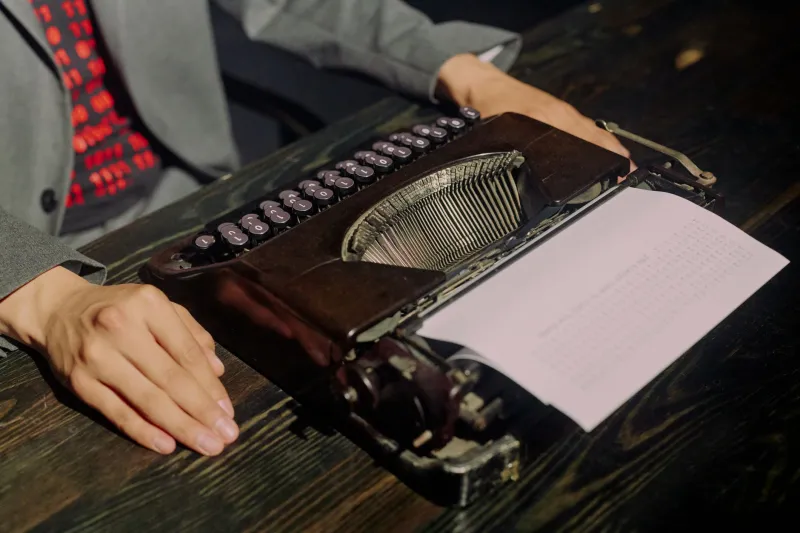
This is not an isolated incident. Across the United States, a genuinely baffling cultural movement is gaining serious momentum: people are voluntarily choosing hobbies, tools, and technologies that require effort, patience, instruction manuals, and — crucially — a pretty high tolerance for failure. Mechanical typewriters. Vinyl record setups with seventeen different components. Darkroom photography. Analog synthesizers with patch cables going absolutely nowhere logical. Hand-ground coffee that takes twenty-five minutes to produce a single cup.
The friction is not a bug. The friction is the entire product.
The Frictionless Life Turned Out to Be Kind of a Bummer
Here's the thing nobody put in the brochure for the digital revolution: when everything becomes effortless, effortlessness stops feeling like anything. Streaming a movie used to require driving to Blockbuster, hoping your title wasn't already rented out, and rewinding the tape when you were done. Now it requires blinking in the general direction of a remote control. Convenient? Absolutely. Satisfying? Increasingly, it seems, no.
Psychologists have a term for this — the "effort heuristic" — which essentially means humans are wired to assign more value to things they work for. The harder you had to try, the more the result means to you. Digital convenience quietly dismantled that equation across virtually every corner of modern life, and now a growing number of Americans are staging a low-key, high-commitment revolt.
They're not smashing their iPhones. They're not writing manifestos. They're just... buying typewriters and refusing to feel weird about it.
The Typewriter People Are Not Who You Think They Are
The popular image of the analog enthusiast is some variation of a mustachioed guy in suspenders who also makes his own hot sauce. And sure, that person exists. But the actual demographic landscape of the Great Analog Rebellion is considerably weirder and more interesting.
There are software engineers who spend their weekends hunting for Olivetti Lettera 32s on eBay because staring at a screen all week has made them desperate for something tactile. There are Gen Z college students who have never not had WiFi but who are building darkrooms in their bathroom closets because the idea of waiting for a photograph to develop feels, in their words, "genuinely exciting." There are suburban moms who took up hand-cranked pasta making not because it's faster (it is spectacularly not faster) but because the repetitive mechanical action of it is the most meditative twenty minutes of their entire week.
The instruction manual, once the universal symbol of annoying adult responsibility, has been quietly rehabilitated into a kind of trophy. You have a thing complex enough to require a manual. You are learning it. You are becoming a person who knows how a thing actually works.
That's a flex now.
Vinyl Is the Gateway Drug, and Everyone Knows It
If you want to understand how this movement operates in the wild, vinyl record collecting is your clearest case study. The resurgence of vinyl has been going on long enough that it's no longer surprising, but what's interesting is how the hobby has evolved. It's not just about owning records anymore. It's about the setup. The turntable. The stylus. The preamp. The speakers. The ritual of cleaning the record before you play it, of flipping it manually at the halfway point, of accepting that if you want to skip a song you have to physically pick up the needle like some kind of animal.
Record stores — actual, physical record stores — have been opening in cities across the country at a rate that would have seemed delusional a decade ago. People aren't just buying albums. They're buying the experience of buying albums: flipping through crates, having opinions about pressings, learning what "VG+" means in a condition grade. They are participating in a system that requires knowledge, patience, and the occasional expensive mistake.
They love it. They talk about it constantly. They have turned "I have a record player" from a simple statement of fact into an entire personality, and nobody is even that mad about it.
The Status Symbol Has a Learning Curve
What's genuinely new about this moment — what separates it from previous waves of retro nostalgia — is the way difficulty itself has become aspirational. It's not enough to own the vintage camera or the manual typewriter or the analog synthesizer. You have to actually learn to use it. You have to be seen struggling with it, and then slowly, visibly getting better.
This is playing out spectacularly on social media, which is both the irony and the engine of the whole thing. TikTok and Instagram are full of people documenting their analog journeys in real time: the first terrible photographs from a film camera, the typo-riddled first page from a typewriter, the patch cable chaos of a modular synth setup that produces something that sounds less like music and more like a dial-up modem having a rough morning.
The vulnerability of being a beginner, of showing the process rather than just the polished result, has become its own kind of currency. In a content landscape saturated with effortless expertise and algorithmic perfection, watching someone genuinely fumble their way toward competence is weirdly riveting.
What the Machines Are Actually Giving Us
Ask someone deep in the analog rebellion what they're really getting out of it, and the answers are remarkably consistent. Focus. Presence. The specific satisfaction of understanding exactly how a thing works because you had to figure it out yourself. A sense of time that doesn't feel like it's being algorithmically managed on their behalf.
There's also something that's harder to articulate but shows up in almost every conversation: the relief of an activity that has a clear end point. You finish the roll of film. You type to the bottom of the page. The record ends and you have to flip it. In a world of infinite scroll and endless queues and content that regenerates faster than you can consume it, the machine that runs out — that stops and waits for you to do something — turns out to feel like a small, beautiful mercy.
So yes. The instruction manual is back. The jammed mechanism is back. The "why won't this work" spiral is back, and people are choosing it on purpose, with their whole chests, on a Saturday afternoon when they could theoretically be watching anything they want with the push of a button.
Turns out "anything you want" gets exhausting. Sometimes what you want is a machine that makes you earn it.