Blankets, Pillows, and Zero Apologies: The Unhinged Adult Fort Movement Taking Over America's Living Rooms
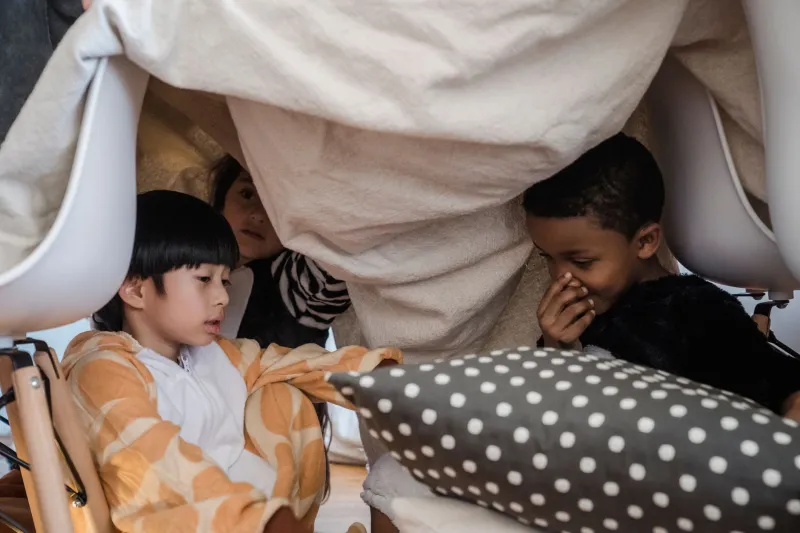
Let's set the scene. It's a Tuesday night. You have a mortgage payment due, a performance review pending, and a text from your landlord about the parking situation. You have exactly two options: spiral productively into adulthood, or drag every throw pillow you own into the living room, drape a king-sized duvet over your dining chairs, and seal yourself inside a cocoon of flannel and denial.
More Americans than you'd expect are choosing Option B. Enthusiastically. Repeatedly. And without a hint of embarrassment.
The adult pillow fort trend has graduated from quirky internet novelty to a full-blown lifestyle movement, complete with dedicated subreddits, TikTok tutorials with seven-figure view counts, and people — real, employed, tax-paying people — spending upward of $300 on premium fort-building supplies. Fairy lights. Tension rods. Weighted blankets rated for structural integrity. Clip systems designed specifically for securing fabric to furniture without scratching the finish.
Yes, there are fort clips now. We've arrived.
How Did We Get Here (And Can We Stay?)
The honest answer involves a pandemic, some collective burnout, and the slow cultural realization that adulthood, as advertised, is kind of a scam.
Fort-building spiked dramatically during the early lockdown years, when people had nothing but time, anxiety, and a suspicious amount of excess bedding. But instead of fading out once the world reopened, the behavior quietly calcified into habit. Then it evolved. Then it got a hashtag. Then it got a community. Then someone started selling fort kits on Etsy for $89 and sold out in four days.
Now, in 2025, the pillow fort is having what can only be described as its main character moment.
Social media is flooded with adults documenting their constructions with the pride of someone who just finished a home renovation. And honestly? Some of these things are architecturally impressive. We're talking multi-room configurations. Reading nooks within sleeping nooks. Dedicated zones for snacks. One viral TikTok featured a woman who built a blanket fort specifically to watch the entire Lord of the Rings extended trilogy, including a built-in "second breakfast shelf." It had 2.4 million likes. The comments were not ironic. People were genuinely inspired.
The Wellness Industry Notices (And Immediately Tries to Sell You Something)
Where humans gather in cozy rebellion, the wellness industry follows with a clipboard and a pricing gun.
What started as a spontaneous, zero-budget act of soft chaos has attracted the attention of brands eager to monetize the vibe. There are now "adult fort kits" marketed explicitly as stress relief tools. Weighted blanket companies have pivoted their copy to include fort-friendly language. One startup launched a $175 "Cozy Architecture Bundle" that includes a tension rod set, velcro attachment strips, and a printed instruction card that reads, in earnest, "Build your sanctuary."
Therapists, to their credit, aren't entirely dismissive of the trend. There's a legitimate psychological concept called "restorative environments" — spaces that feel safe, bounded, and low-stimulation — and a well-constructed blanket fort checks every single box. Small enclosed spaces can genuinely reduce sensory overload. The dim lighting, the soft textures, the physical barrier between you and the rest of your apartment full of responsibilities — it's not nothing.
Dr. Google (and several actual psychologists quoted in actual publications) will tell you that this kind of intentional regression is a valid coping mechanism. Creating a small, controllable environment when the larger world feels chaotic is a deeply human impulse. Children figured this out instinctively. Adults just needed a decade of collective trauma to remember it.
The Pinterest Board Is Not Playing Around
If you wander into the fort-building corners of Pinterest, you will not find sad, wrinkled bedsheets thrown over two chairs. You will find visions.
Elaborate canopied structures with string lights threaded through cotton gauze. Outdoor fort builds using pergola frames and linen drapes. "Winter fort" aesthetics featuring faux fur throws, cedar-scented candles, and a very specific color palette that can only be described as "expensive cave." The Pinterest boards have titles like "Cozy Chaos," "Soft Architecture," and — our personal favorite — "My Apartment But Better."
The community aspect is genuinely heartwarming in a slightly deranged way. People share their builds, offer structural advice ("the double-clip method on the sofa arm is a game-changer"), troubleshoot collapses with the patience of engineers, and celebrate each other's finished forts with the kind of enthusiasm usually reserved for major life events.
Someone posted a photo of their completed fort last winter with the caption: "Took me three hours and I've never felt safer in my life." It got 47,000 saves.
Does It Actually Work, Or Are We All Just Regressing Beautifully?
This is the real question, isn't it.
The cynical read: adults building blanket forts are simply refusing to cope with reality in a slightly adorable way, spending money they don't have on clip systems and fairy lights to avoid sending emails they've been putting off since Thursday.
The generous read: they've found an accessible, low-cost (or medium-cost, depending on how deep they go down the Etsy rabbit hole), genuinely effective method of resetting their nervous system in a world that offers very few opportunities to feel small and safe and entirely unbothered.
Both reads are probably correct, and that's fine. The human capacity to find comfort in soft, enclosed spaces is ancient and real. The fact that we've now built an entire aesthetic movement and a small retail economy around it is just very, very on-brand for the current era.
The people who build these forts consistently report the same things: they sleep better in them, they feel less anxious inside them, and the act of building something with their hands — even something structurally precarious — gives them a sense of agency that the rest of adult life frequently denies.
There's also something quietly radical about it. In a culture that prizes productivity, optimization, and the relentless performance of having-it-together, crawling into a blanket fort and refusing to come out until you're ready is a small act of soft defiance. You are not grinding. You are not networking. You are not responding to that Slack message. You are in the fort. The fort is your world now.
The Bottom Line
If you have not yet built an adult blanket fort, we're not saying you need to. We're just saying that a not-insignificant number of your fellow Americans are currently inside one, feeling genuinely peaceful for the first time all week, and they are not taking questions.
The supplies are affordable. The instructions are on TikTok. The weighted blanket is in your closet from that phase you went through in 2022.
Build the fort. The emails will still be there when you emerge. Probably. Hopefully. Actually, don't think about the emails right now. You're in the fort.